
Believing is not an achievement.
It is in the reasons for belief that the value is held.

I’ve only been on Substack for 5 months or so. I initially wanted to write to a) straighten out my own thoughts on a few things and b) try and tackle some of the embarrassingly fundamental epistemological mistakes (mostly) Christians make when it comes to their religious beliefs. I’m certainly not saying that non-Christians don’t also make embarrassingly fundamental epistemological mistakes, and I am sure I’ve made a few myself here and there. But it is becoming clear to me that even the most reasonable Christians don’t have good reasons for their beliefs. They have reasons, sure - but they fail to demonstrate the truth of their Christian beliefs. Every single time. I’ve engaged at length with many Christians and they all fall into one of three categories:
Christians that have flawed epistemologies and so are unaware that their reasons are flawed and their evidence doesn’t demonstrate what they think it does. It is, of course, their broken epistemology that allowed them to become Christians in the first place - broken or stunted by childhood indoctrination or perhaps trauma as an adult.
Christians that have excellent epistemologies and so don’t actually believe. They won’t admit that they don’t actually believe, of course, and hide it behind a wall of deflection and neat-sounding poetry. It might be convenience, community, money, identity - but for some reason they cling on like ticks to a belief system they have to distort beyond recognition to be able to live with.
Christians that have achieved an incredible feat of cognitive dissonance and have managed to balance an understanding of why they are not justified in holding their belief alongside a genuine belief.
Of course, when challenged, all three groups go into defence mode which involves the following four actions in this order:
An attack on the meaning of the word atheist “actually it means you think you prove a god doesn’t exist, so go ahead”. No, atheist means “not a theist”. You are a theist and I’m not. You say a god exists and I don’t believe you. I can’t prove god doesn’t exist, other than if one did, there’d be sufficient evidence and there ain’t.
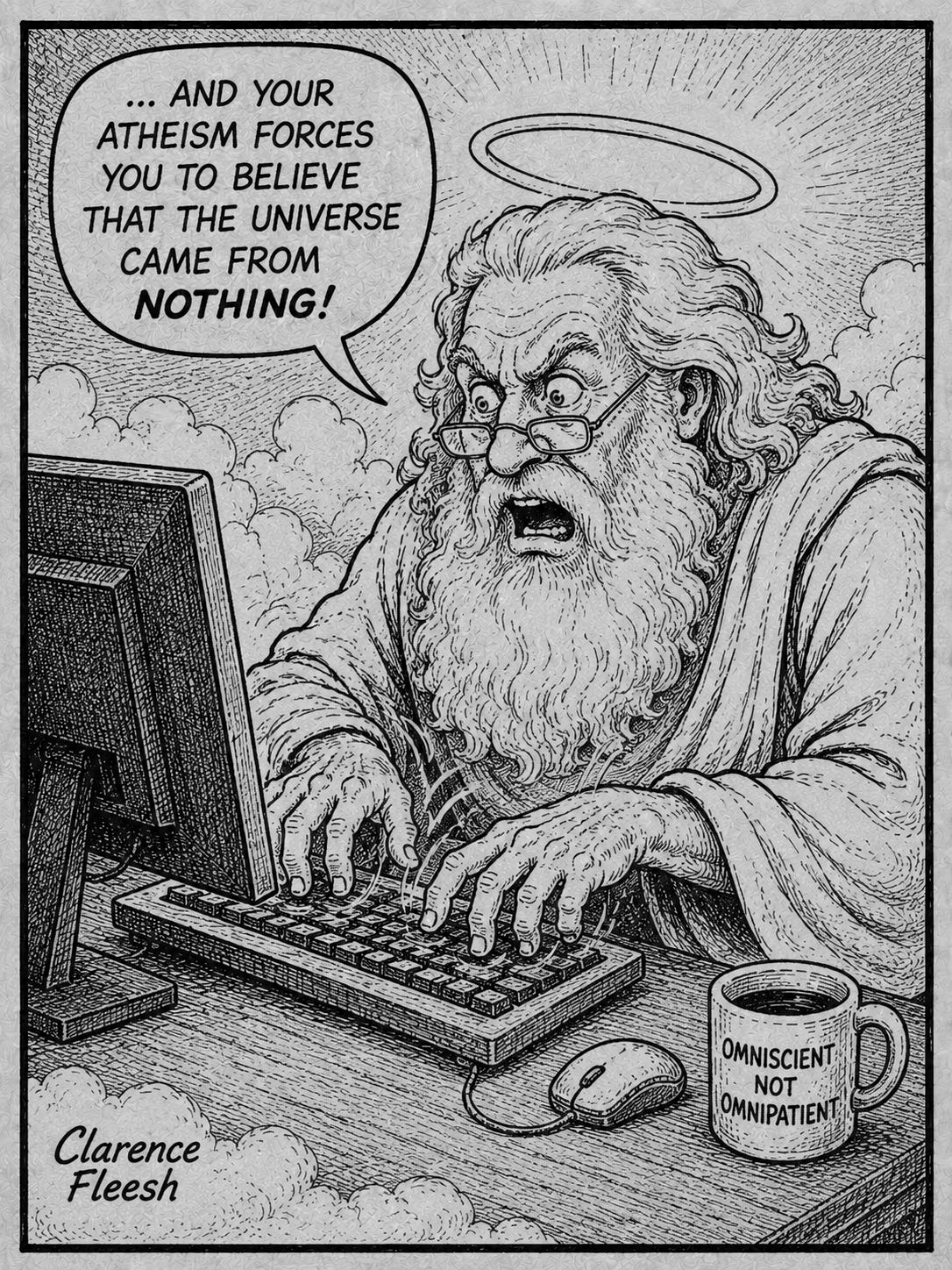
A false dichotomy: “your atheism forces you to believe that the universe came from nothing”. Incorrect. My atheism means I think you are full of shit and nothing more. I don’t know where the fucking universe came from, and your god still doesn’t appear to exist.
Weaponised philosophy. The worst kind of reason to believe in a god. Things that exist don’t need rationalising into hypothetical existence with philosophy (the art of being wrong using poetry) rather than actual evidence.
Personal attack: You deny the evidence; you know it’s true really, you would deny it even if god landed right in front of you (which he hasn’t), you are ideologically opposed to religion and so are unworthy of this conversation etc.
Let me be clear. I will believe anything - ANYTHING - that can be shown to be true. But my standards are high and I know about bias, so I need evidence ratified by the wider community of other reasonable people and, most importantly, science. Science can study anything - ANYTHING - that interacts with the physical universe in a detectable, measurable way. If god heals, answers prayers, increases human wellbeing, gives moral guidance, talks to you - we can study it. If you can’t imagine how, then you underestimate science or have a limited imagination or, most likely, both.
In fact, I don’t believe anything - ANYTHING - that can’t be shown to be true. And I don’t believe in anything that I am unable to fully comprehend, even if I am able to understand that it might be reasonable to. For instance: do I believe that the Big Bang is the beginning of the current presentation of the universe? No. What I DO believe is that the Big Bang is the current scientific consensus explanation based on data and evidence for the beginning of the current presentation of the universe. I would not try and convert you to be a Big Bang follower, or attempt to worship the Big Bang or even swear it was true: I believe in science, not the event itself, which I am unfit to fully comprehend. So I remain in a neutral and reasonable middle ground. I don’t believe in gravity, I believe that it is the current scientific consensus reason behind us mostly staying planted on the ground and having a moon that orbits us. I can see it in action so know the effects of gravity are as described, but I have not made gravity a world-view that I pin my identity on. Do I believe I can play the guitar? Yes. I have evidence for this which I can fully comprehend and so I can truly believe that I can play the guitar. There is little evidence I am any good at it though.
So a reasonable person has three responsibilities:
To understand the nature of reason, evidence and bias.
To apply that understanding to everything all the time until it is second nature and you can stop thinking about it, but then think about it anyway.
Withhold belief in anything that fails to reach your high standards of reason and evidence. That doesn’t mean denying what you know to be true or being so cynical that you can’t believe anything, it means being reasonable and reacting honestly to the quality, amount and nature of the evidence and cross referencing this with the consensus of experts.
If you have settled on your belief and are working on finding reasons to rationalise that belief, you have failed on point-1.
If you have settled on your belief because you have sufficient evidence and have completed point-1, share the evidence - because it will change the world and every reasonable atheist, Hindu and Muslim will convert to Christianity.
If you believe purely on faith, then you have joined the Hindus, Muslims, ancient Kemetics and Hellenists and a multitude of others on a vast list of theists who all use faith to believe in their various and contradictory gods and who think all others are wrong (and should probably be burned). If you are on this list, you have no claim to reason because faith is inherently unreasonable. If you don’t understand why, that is the gap that allows you to believe through faith.
If you want to be reasonable and don’t have sufficient evidence and are not satisfied with faith alone, then by all means hold the idea of Christianity as a desirable maybe, a lovely sounding possibility, an “I wish it was”. But you shouldn’t believe it, at least not yet.
MQT