
My real life ghost experience.
A tale of ghosts, the written word, evidence and reason.

When I was 22, I lived in a flat at the top of an old Edwardian terrace of houses in southwest London, just a short walk from Fulham Broadway, with my wife. We were pretty poor back then and were extremely lucky to find such a great little flat in such an interesting, fashionable, and pleasant part of London that we could afford. It was right in the roof of the building. The living room was also the bedroom, one big space with skylights that revealed the almost complete lack of sunshine during the day and stars at night. London lacks both to an almost comical degree.
On the first night, we slept fitfully in our new place. We were a little uncomfortable as we didn’t yet have a bed and were sleeping on camping beds borrowed from my mother. At about 1am, the door to our room gently and silently swung open. We only noticed when the door handle quietly knocked the wall behind it. There was a subtle breeze, probably coming from the open window in the bathroom, so I got up and pushed the door closed, ensuring the latch clicked firmly into place, which it did.
I got back in bed and the door immediately started to swing open again. We laughed, and I comically groaned as I got back up and closed it again, this time with a good slam and a wiggle to make sure it had fully seated. I returned to bed and almost immediately the door opened again, alerting us with another knock as the handle gently hit the slightly dented plasterwork behind it.
This time it felt weird, as if things had suddenly got serious. We had a dim night light running, and when I looked at my wife in the darkness, her big round eyes were staring back at me, unmoving. I got up and closed the door again, again testing the latch, which was secure and actually quite hard to disengage with the perfectly round brass door handle. I returned to bed and this time we watched the door under the dim glow of our night light. Nothing. We talked a little about it and eventually drifted off to sleep. We awoke the next day with the door wide open.
I took apart the door mechanism and replaced the little coiled spring that keeps the latch engaged with a new one. I checked everything about that door. There was no way it could open on its own.
The internet was in its infancy back then. I decided to do some research at a local internet café and found a story from a London newspaper dated back to 1910. The article described how a young woman was kept from the world by her father to hide her accidental pregnancy, and once the child was born the father kept both mother and baby locked away in an attic room. And then, one day in Autumn 1909, a neighbour who noticed the house had become unusually quiet found that the entire household had succumbed to scarlet fever. The article didn’t mention a house number, but did mention a street, our street. And, by the sounds of it, our attic flat. We theorised that the door opening was the ghost of that poor boy and his mother trying to leave their attic prison night after night.
No, not really. I made it up.
I littered it with true bits from my real life, real areas of London, details from reality, little things to add authenticity and make it seem more convincing. But it’s a lie. I have never had a ghost experience and don’t believe anybody has because ghosts are pretend until otherwise demonstrated.
Imagine believing something somebody wrote without considering that they did exactly what I have just done: made it all up. Claims of ghosts, miracles, multiple witnesses to those miracles, healings, near death experiences. Sure, it could be true, but equally it could not be.
The recorded history of Henry VIII could be subject to the same fictions, but luckily nobody is using Henry VIII as a moral guide, a lifestyle, a framework for behaviour, for informing their voting habits, for how they treat other people, for leading their engagement with the world. Nobody has ever declared war or enacted atrocities against those that believe a different and possibly contradictory set of maybe-pretend Henry VIII historical records someone wrote.
Someone? Even “someone” is problematic. That was written by Paul? Maybe it was written by someone using a pen-name, authors do that all the time, including me right now. Or maybe someone else invented the name centuries later, as the church routinely did to grant texts apostolic authority.
In the end it must all come down to evidence.
Here’s a claim now: I am a camel. Is that evidence that I am a camel? No, of course it isn’t. If I cannot provide the accompanying evidence that I am a camel, how seriously should you take my claim? Swap camel for the resurrected Christ and there is no difference in the quality of the argument: both are claiming something that common sense tells you is highly improbable (we know people don’t resurrect and we know camels don’t use Substack) and both are as yet unsupported by evidence beyond the claim itself, which, as I already demonstrated, could be made up.
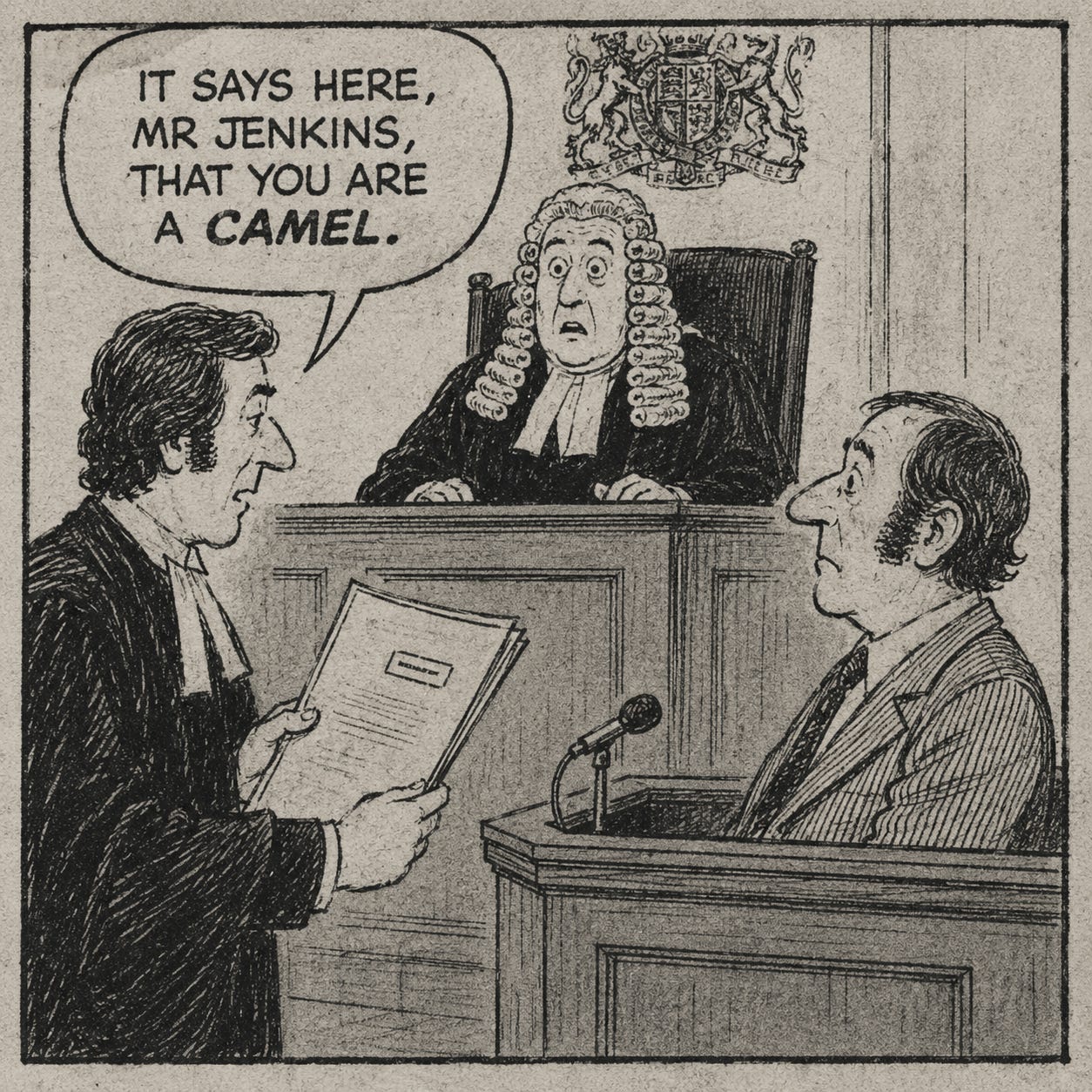
If you can’t demonstrate the truth of something beyond reasonable doubt, then you shouldn’t believe it. You should remain in a state of neutrality about it. Neither believe it nor disbelieve it. And only change your view when new evidence is brought to bear. Belief should track evidence, not desire, tradition or repetition. That is the reasonable position, there isn’t another.
This was prompted by two things this week. First, a podcast retelling the Bell Witch story, a family in Adams, Tennessee, in the early 1800s, supposedly haunted with such severity and documented so thoroughly that the host treated it as genuinely chilling. I didn’t think so. Someone probably just made it up.
Second, an ongoing thread on Substack with Christians who think the bible is straightforwardly true, untruths and all, like a global flood with no geological evidence and an ark too small for the biodiversity it claims to have saved. Yes, certain places and people mentioned in the bible existed, the same way Fulham Broadway exists in southwest London, the same way Henry VIII existed. None of that lends a single ounce of credibility to the resurrection, the virgin birth, or a god intervening in human affairs, any more than a real location lends credibility to my fake ghost story. Corroborating the scenery does not corroborate the magic.
People make up stories. People embellish. People lie. People have biases and motivations that push their understanding of an event in specific directions. So, to make sure we believe only true thing, we need good evidence.
Without evidence, at best we have a compelling story.
At worst we have a great big magnificent lie.
MQT