
What is an atheist?
A second attempt at explaining a position Christians rarely understand.

Rather than attempt to speak for all atheists, I will only speak for myself, but I think my experience and understanding is pretty standard amongst atheists.
I am an atheist because I am not a theist.
A theist is a person who believes in the existence of a god or gods. And I am not one of those.
If a decision is said to be moral, then it is aligned with that which is “good”. If something is said to be amoral, then it has no moral content. It is not the opposite of moral, which would be immoral and therefore “bad“ - it is without moral content: neither good nor bad. That little “a” at the beginning is doing a very specific thing: it is not a claim of opposite, it is the claim of absence1.
A theist believes. An atheist, through the addition of the little ‘a’, is without belief. Like the distinction between amoral and immoral, an atheist does not claim the opposite of believing a god exists, which would be that a god doesn’t exist. An atheist is simply without belief in god.
Technically, new born babies and rocks are also atheists because they are without belief. But that would be an odd claim to make seeing as neither are capable of any beliefs.
So the term atheist is about believing. The term agnostic deals with something else: knowledge. There’s that little ‘a’ again: gnostic means “with knowledge”, agnostic means ”without knowledge”. Without knowledge that a god exists and without knowledge that a god does not exist.
It is inadequate to simply call someone an agnostic, because it only speaks to knowledge and can be applied to any subject. Where do I stand on the existence of Dark Matter? I am agnostic. I do not have the knowledge to form an opinion for or against the claim that Dark Matter exists.
I am an atheist because I don’t believe a god exists. I am agnostic on the subject of god’s existence because I don’t have knowledge of a god existing or not existing - a neutral state of knowledge. And a neutral position of knowledge cannot reasonably lead to a belief.
I don’t know if Bigfoot exists or not. So I do not believe in Bigfoot. However, because I am a reasonable person, if new evidence is presented, I will reassess my position and my mind could be changed.
“Could be changed”? Isn’t that a strange way to express it? Wouldn’t you actively change your mind? No. We do not choose what to believe; it is an involuntary, subconscious decision made behind the scenes in reaction to evidence. It is known as doxastic involuntarism.
Many Christians accuse atheists of hating god and think that is why they don’t believe. But to hate a god you would need to believe in one. Otherwise you are just hating the idea of god, like hating Darth Vader. I hate strawberry ice cream, but that hatred does not and cannot result in me forming a non-belief in strawberry ice cream.
I am an atheist because I don’t believe a god exists. I am agnostic because I do not have knowledge whether one exists or doesn’t exist. And I hold these positions through doxastic involuntarism because I did not choose them; they formed subconsciously in reaction to the evidence.
Ah, evidence. The Achilles Heel of religious belief. Believers don’t need evidence because they have faith. But they insist they also have evidence. Yet whenever I ask to see it, it turns out to be useless as evidence. It is either so weak it can be dismissed, doesn’t demonstrate what it is claimed to demonstrate, or isn’t even evidence but is simply a claim.
If you do not understand the nature of evidence, if you cannot apply an unbiased, rational, and sceptical approach, then you have not engaged with the evidence properly and any conclusions you have reached are built on error and not to be trusted.
All reasonable atheists, and I include myself in that group, will change their minds if presented with adequate evidence that a god exists. And I am only concerned with reasonable people. If you saw evidence that demonstrated your own belief to be wrong, would you change your mind? If yes, then you are reasonable. If not, then you are not reasonable.
If you have faith and no amount of evidence would change your mind, then you are not reasonable. If you were crossing the road and didn’t see a car coming so decided to cross but then, at the last moment, saw a car coming, would you change your belief from “no cars are coming” to “shit, a car IS coming” and act accordingly? Of course you would. And you would do this because you want to be reasonable so you don’t get hit by a car. If you are a reasonable person, you apply exactly this reasoning to all your beliefs: you change your beliefs according to the evidence. And this is where an accurate assessment of the evidence becomes critical.
If you have poor eyesight, or are in fact blind, you are going to find it hard to check for cars when crossing the road. You are likely to make a poor judgment and get hit by a car unless you somehow improve your ability to check for cars. So not only must you look for cars before crossing the road, you must make sure the apparatus you use for assessing the evidence of cars is up to the job, because otherwise the consequences are error, pain, and possibly death. A blind person may improve their ability to cross safely by using a pedestrian crossing or asking a trusted person to look for them. This is an analogy for your ability to assess evidence. If you cannot accurately assess evidence, such as whether a car is coming or not or whether a god exists or not, then you will make a mistake.
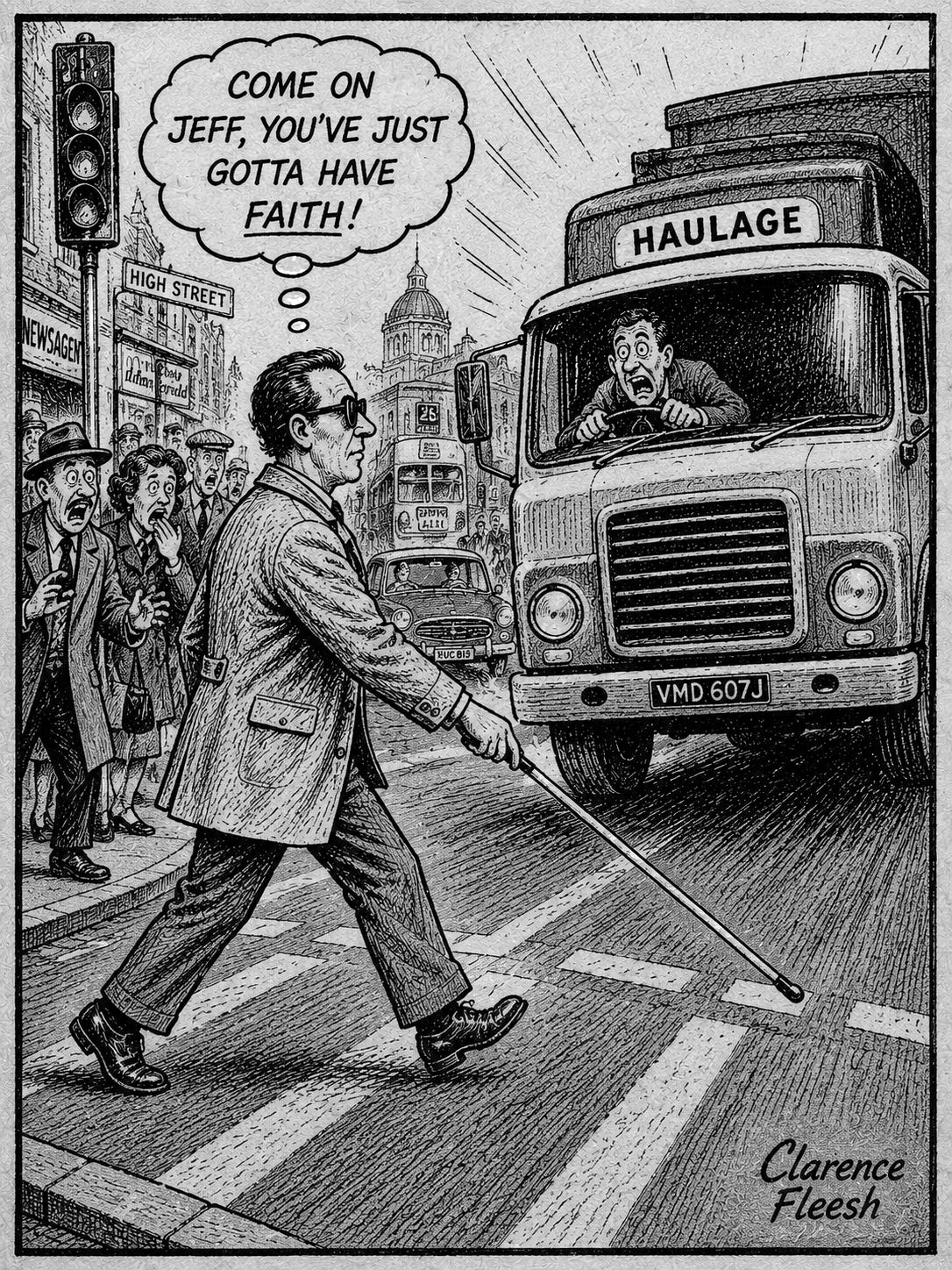
So, I am an atheist because I don’t believe a god exists. I am agnostic because I do not have knowledge whether one exists or doesn’t exist. I hold these positions through doxastic involuntarism because I did not choose them; they formed subconsciously in reaction to the evidence. The evidence has not convinced me because it is insufficient. And I am confident of my assessment of the evidence because I apply a rational, sceptical, informed approach. And I maintain this approach because I am a reasonable person who, much like someone crossing the road, prefers to ensure my apparatus for assessing reality is actually up to the job so I don’t make a mistake.
A god might exist. And when it is demonstrated to, I’ll believe in it. So rather than argue about what atheism actually means, just provide the evidence for your god and we’ll see if your belief is reasonable. If it is, you’ll convert me. If it isn’t, and you want to be reasonable, you’ll abandon it.
MQT
Addendum: someone pointed out that the word atheist is ACTUALLY derived from the ancient Greek word “atheos”, meaning without belief or godless. “A” meaning without or not and “theos” meaning god. I am not sure why they needed to spend 250 words petulantly pointing out that how I was wrong, which I wasn’t - perhaps it was because I asked for evidence for god and they panicked.
I think this is a very good summary of the atheist position. You are right: there is no direct scientific evidence for God. But what often happens with atheists, including figures like Richard Dawkins, is that they turn a blind eye to the more esoteric and mystical dimensions of life. They can fall into a rigid worldview where the demand for scientific evidence overrides the primacy of immediate experience.
There are many things in life for which there may never be direct scientific evidence, yet they exist in consciousness as vividly and meaningfully as anything else. Entertaining non-scientific, mystical, or esoteric explanations is not the same as admitting that they are true. It simply means remaining open to possibilities that science may not yet be equipped to measure or explain.
My argument against atheism is not that it is stupid. It is that, in practice, it often comes at the cost of becoming closed off to alternative explanations. None of us will be here in a thousand years to see what science eventually catches up with. So why not entertain even the strangest ideas now? Some of them may turn out to contain more truth than we currently imagine.